For K-12 school districts and families
The micromobility & e-bike safety
compliance platform.
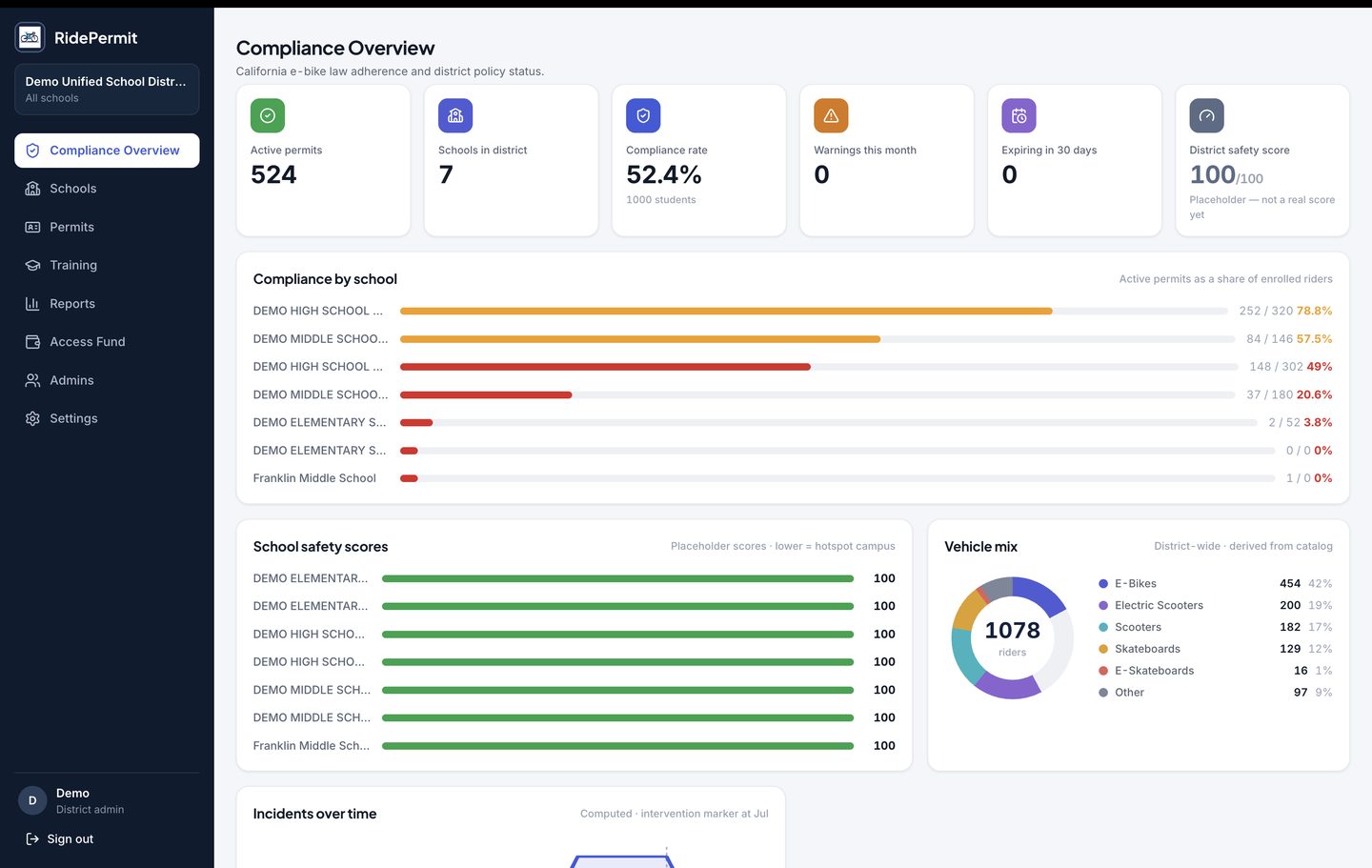
Registration, configurable safety training, certification, campus attestation, device legality, and stolen bike recovery. Every e-bike, scooter, and mobile device on campus in one record with district-wide reporting.
 PeopleForBikes
 CalBike
 League of American Bicyclists
 NBC
NBC Voice of OC
 KNX 1070
 KFI AM 640
Built for everyone in the loop
One platform. Three people it has to work for.
A district needs a record it can defend. A parent needs a process that fits in an evening. A student needs training that actually changes how they ride.
For districts
Set your policy once. See every device on every campus, who is trained, who is outstanding, and a record that holds up when a board or insurer asks.
See the district platformFor parents
Register the device, complete the training together, get the digital permit and decal. Under an hour, on a phone, and nothing to pay when your district is on RidePermit.
How it works for familiesFor students
Four modules that teach and then test, completed in any order, built from national safety curriculum. Learn it, prove it, ride with a permit that means something.
See the trainingWhat the platform does
Six jobs. One record per device.
Districts currently spread these across a form, a video link, a spreadsheet, a sticker drawer, and a phone call to the front office.
Registration
Parents check the e-bike's legality and register online. Permits issue digitally and as a physical decal. Every e-bike, scooter, one-wheel, and bike on campus in one record.
Configurable training
Four modules, Ride Ready, Stop the Crash, Know Your Bike, and Power Safe, each teaching then testing. Use our curriculum, add your own, or point families at another provider.
Certification
Uploaded certificates are checked for a passing grade in the right student's name, whoever issued them. Completion is tied to the permit, not filed in a drawer.
Campus attestation
Parent and student both sign your campus conduct rules. Your wording, dated, retained, and attached to the permit record.
State law and district rules
State law is enforced as the floor, your district policy sits on top. A permit issues only when both pass, checked at issuance, not as a warning someone clicks past.
Recovery and identity
A scannable decal on every permitted device. A stolen bike is identifiable instead of anonymous, and after an accident or incident a parent is reachable with one tap. The system connects the call, with consent the parent gave at registration, and the caller never sees their number.
Rider training
Learn it. See it. Prove it.
Four short visual lessons, Ride Ready, Stop the Crash, Know Your Bike, and Power Safe, each with a no-pressure knowledge check. Then four graded assessments, fifty questions across the course, 40 to pass. About twenty minutes, in any order, progress saved automatically.
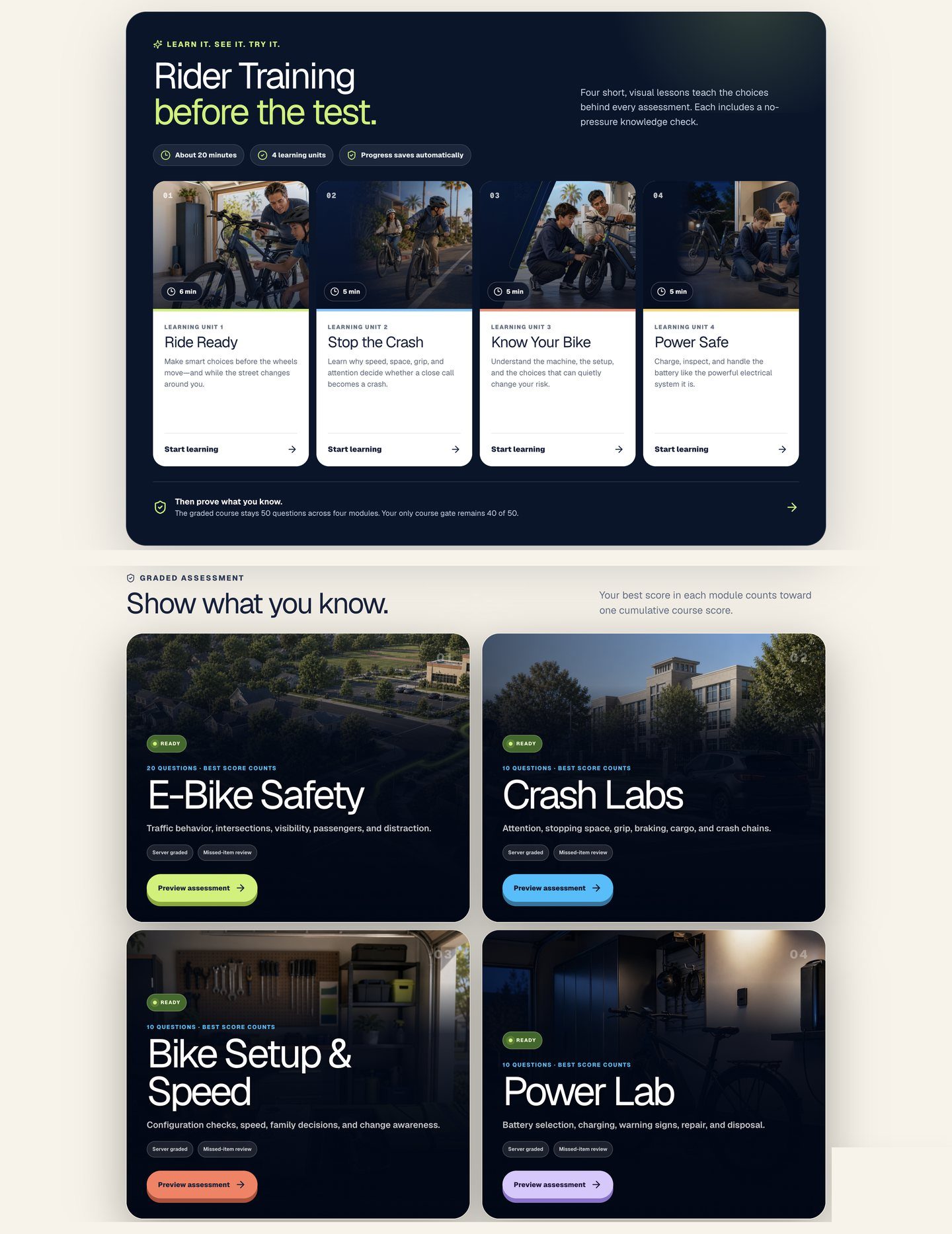
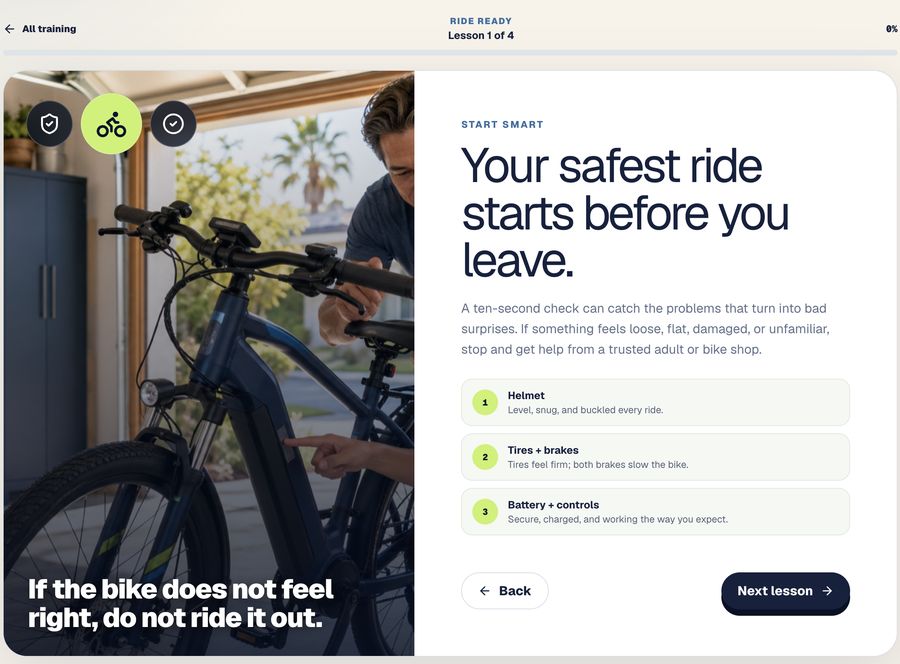
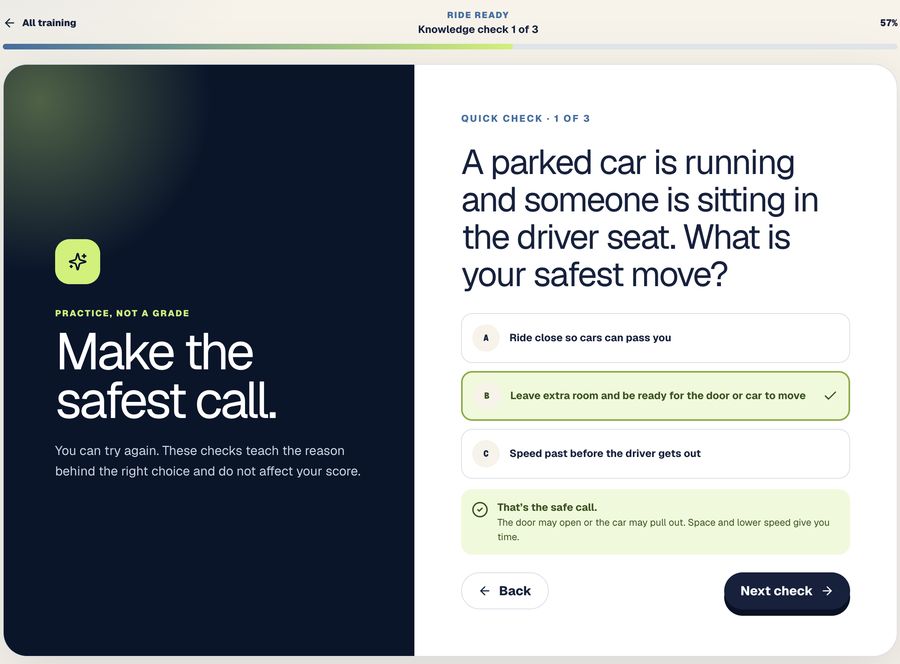
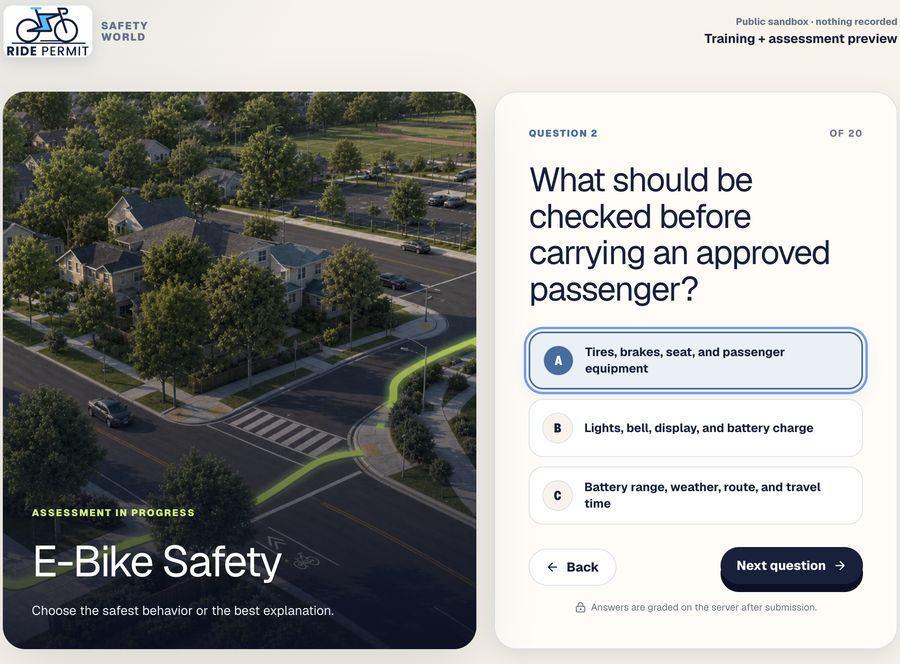
Districts can use this curriculum as included, add their own videos and local rules, or accept another provider's certificate. Whichever path, completion is recorded on the student's permit with the date and the score.
Why now
Student e-bike ridership arrived faster than any policy to manage it.
The injuries are real, the free certificates prove nothing, and no state has handed districts a finished answer.
The law says act, not how
Where legislatures have moved, they have mostly encouraged rather than required, and softened bills to avoid burdening schools. Every district ends up writing its own policy alone.
The free certificate proves nothing
The public safety courses most districts point families to issue a certificate with no name, no date, no score. A school cannot tell whose it is, or tell it from a screenshot.
Nothing connects to anything
A form, a training link, a paper attestation, a weekend inspection, a numbered sticker. The sticker does not reach the training record, and nothing reaches the parent.
How it runs
Set the policy once. The rest happens without chasing anyone.
Most district programs fail on administration rather than intent. Every step that needs a staff member is a step that does not get done before school starts.
District sets policy
Permitted classes, minimum age, helmet rules, and campus conduct terms. State law is already underneath.
Family registers
On a phone, with the device checked against state law and district policy as they type it in.
Student trains
Module by module, tested as they go. Parent and student sign the attestation together at the end.
Permit issues
Digital immediately, decal mailed to the home. Both tied to the same record the district can see.
Free for everyone
Two tools that need no account.
Most families find out their bike is the wrong class at the school gate. These exist so they find out first.
Is my e-bike legal?
Enter the make and model. Get the class, the minimum age, and whether it can be ridden to school in your state. Over 2,000 models catalogued.
Check a bikeState e-bike laws
Class definitions, age minimums, helmet rules, and where each class may ride, for all fifty states, with the statute cited on every rule.
Find your stateSee it, not read about it
Watch the platform run.
Short walkthroughs for each audience, and a full demo library for district teams evaluating it properly.
Bring your current permit rules.
We will configure them into a live portal and walk your team through it in about thirty minutes.